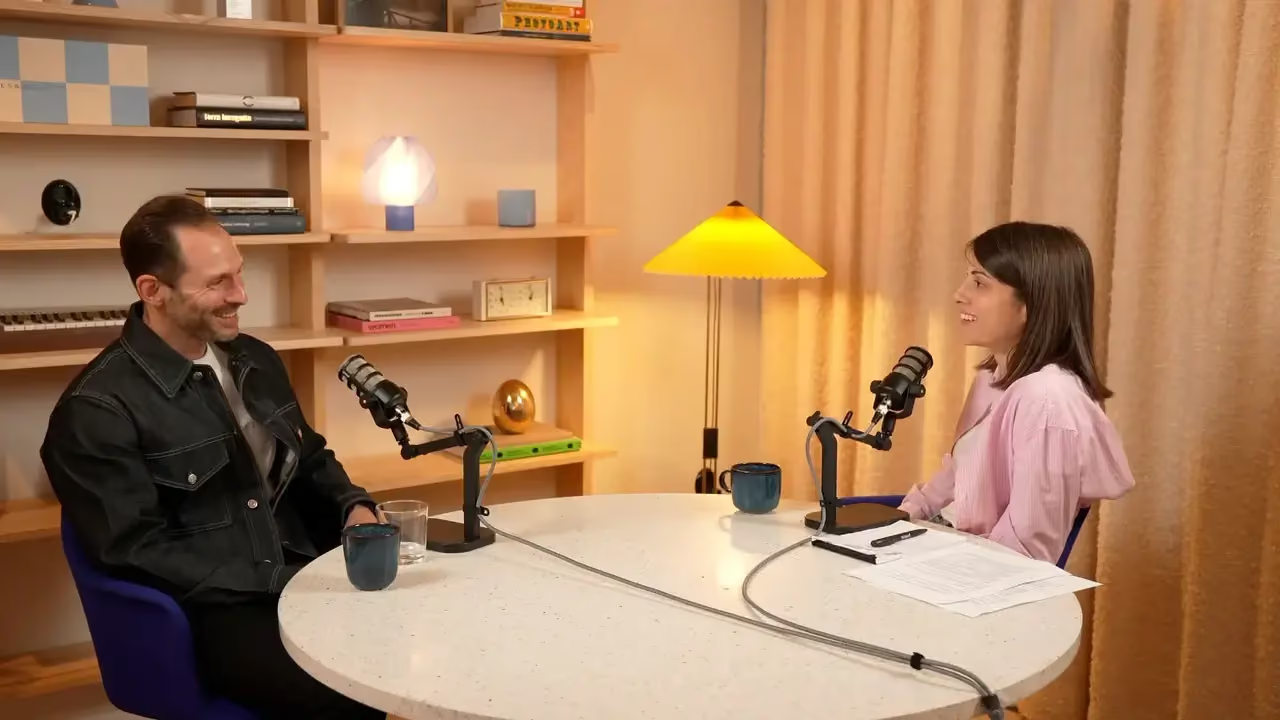
There's a version of the AI anxiety that most marketing leaders are privately feeling but not quite saying out loud: it's not really about the machines. It's the nagging suspicion that the foundations were already shaky before the machines arrived.
In Part 2 of this conversation, Jan Montwill, Global Media Strategist at H&M, makes that suspicion explicit… and then does something more useful than most: he explains what to do about it. Jan has spent his career across agencies including WPP and Havas before going client-side, which means he's watched this from both sides. His take is calm, grounded, and deliberately uncomfortable in the best possible way: the marketers most at risk from AI aren't the ones being replaced by automation. They're the ones who never built the strategic foundation that makes automation useful in the first place.
Here's what Part 2 covers and why it matters more than the AI headlines.
Why the marketing skills gap predates AI and why it matters now
Jan's central argument is simple and a little confrontational: marketing deskilled itself. AI didn't do it. Years of collapsing the entire discipline into Promotion (into media buying, platform optimisation, campaign execution) left a generation of marketers who are excellent at operating tools and less confident about the strategic thinking that makes those tools worth anything.
His analogy is pointed: you wouldn't hire a CFO who doesn't understand economics. You wouldn't expect someone to run a kitchen without knowing how to cook. But somehow, in marketing, it became almost a badge of honour to have skipped the theory. The result is that when AI arrived and started automating the execution layer, a lot of people found themselves without much left to offer.
The good news, in Jan's view, is that this is fixable. And the fix isn't complicated! It's just often skipped.
The four P's of marketing: the strategic foundation AI can't replace
Jan's framework for what survives automation is straightforward: anything that requires genuine strategic thinking about your brand, your market, and your customer. The four P's (Product, Price, Place, Promotion) are the clearest expression of that. And yet most marketing conversations, he observes, collapse into just one of them. Promotion. Ads. Media. The budget line everyone can see.
What AI can't do (at least not yet) is tell you how to position your brand distinctively, which customer segments you haven't reached, how your pricing strategy affects brand perception, or what your product should become next. Those are still human jobs. And they're the jobs that will matter most as execution gets automated away.
His point isn't nostalgic as much as it's strategic. The marketers who thrive from here won't necessarily be the ones who master the tools, but they will be the ones who bring better thinking to the same tools everyone else is using.
Brand strategy and positioning: what marketers still control in an automated world
One of the clearest moments in the conversation comes when Jan talks about what marketers still have control over. The answer is: more than most people think, and more important than most people act on.
Brand positioning. Distinctiveness. Customer insight. Category entry points. The relationships with publishers and partners that feed into organic presence. The PR that determines whether your brand shows up when an AI is answering questions your customer is asking. None of this is automated. All of it is upstream of everything else.
When everything on the platforms starts looking the same (same formats, same optimisation logic, same AI-generated variations) the only thing that makes your brand different is what you bring to it. That's a strategy question, not a technology question. And it's one that requires the kind of marketing training most teams haven't prioritised.
AEO vs SEO: why strong organic foundations already put you ahead
Jan's take on agentic search is one of the more grounding perspectives you'll hear on the topic right now: calm down, and check your basics first.
His argument is that 90% of AEO is simply good SEO (evergreen content, credible partnerships, a solid organic presence across the channels that feed the major LLMs…).
- Gemini pulls heavily from YouTube, so a neglected YouTube channel is now a strategic liability.
- Claude pulls from sources like Reddit, so your brand's presence in community conversations matters more than it used to.
- Premium publisher partnerships and PR relationships (the things that have always mattered for organic reach) are now directly feeding into whether an AI recommends your brand or your competitor's.
The 10% that's genuinely new, Jan argues, is about category entry points: reaching someone who's asking "what should I pack for Barcelona?" rather than "H&M running top." That's a different kind of content strategy, and it's worth investing in. But it builds on a foundation that either exists or doesn't.
The brands that have been doing the basics well (organic presence, PR, partnerships, evergreen content) are already ahead in AEO. The ones who haven't will find that no amount of AI-specific strategy fixes a weak foundation.
The future of marketing agencies in the AI era
Jan is clear-eyed about the agency landscape without being dismissive of it.
His view: agencies that are adapting are doing well. Agencies that are clinging to old models (inventory trading, purely manual execution, slow-moving structures) are struggling, and will continue to.
What he expects from agencies going forward is expertise. Not just familiarity with AI tools, but genuine strategic command of what AI means for media and marketing in their clients' specific contexts. The value of an agency, in his framing, has never really been the buying. It's been the knowledge, the pace of learning, the ability to sift through what matters and what's hype, and the manpower to do things a lean in-house team simply can't. All of that still holds — as long as the agency is genuinely keeping up.
For brands, the implication is the same as it's always been: treat your agency as an extension of your team, not a supplier. Share data. Align on measurement. Give them enough context to do strategic work, not just execute briefs.
How to close the marketing skills gap: resources and next steps
Jan is very specific here His recommendations:
- Mark Ritson's Mini MBA in Marketing is his first call — expensive, he acknowledges, but worth it.
- For those without the budget, Philip Kotler's foundational text
- Les Binet's work on the “Long and short of it” (book) are the starting points.
- And if reading feels like too much of a commitment, his suggestion is to use AI itself to build a learning plan: everything is available, the barrier is prioritisation, not access.
His broader point is that this isn't optional for anyone who wants to stay relevant. Marketing training isn't a nice-to-have for senior people. It's the thing that separates the marketers who see AI as an opportunity from the ones who are worried it's coming for their job.
How to apply this to your strategy
- Want to brush up on your marketing fundamentals? Jan swears by Mark Ritson's Mini MBA in Marketing, and for good reason! If that's not an option right now, Les Binet's The Long and Short (book) of It is a great place to start.
- Map your AEO inputs today. Open YouTube, Reddit, and Google and search for your brand and your main category keywords. What comes up? Who's writing about you? Where are you missing? The sources that feed the major LLMs — YouTube for Gemini, Reddit and premium publishers for others — are the same ones you should already be investing in.
- Ask your agency one direct question. "What's your AEO strategy for our category right now?" If they can't answer it specifically, that's worth knowing — and worth pushing on.
- Identify your category entry points. Think beyond your product keywords. Someone searching "things to pack for Barcelona" isn't looking for your brand yet, but if you sell activewear, that's exactly the moment to show up with a running top recommendation. What is your customer planning, doing, or searching for in the moments before they need you? Those are the conversations worth owning.
📩 Subscribe to the Connecting the dots newsletter for bonus content from this episode and every conversation we have.
🎧 Watch the full episode on YouTube or listen on Spotify or Apple Podcasts.
Authors

Stefania Casciari Carter
CMO at Precis
Stefania Casciari Carter
CMO at Precis